Content creation in the good enough economy
Does the democratization of skill leave quality—or taste—behind?
Let’s explore the impact of AI on content creation.
Technology promises to make our lives better.
But with easier-and-faster comes a shift where “better” gets left behind for “good enough.” Remember when Adobe democratized design with Photoshop? It did not take long to tell who was a designer and who simply knew how to use the software. A logo with bevel-and-emboss was the AI em-dash of its time.
Tech can democratize knowledge and skill, and that’s a benefit for many of us. But it doesn't endow taste. That’s the central problem I see when I look beyond generative AI’s hype and take a critical view of the output.
A lot of it is terrible.
Not because it is poorly written or produced, but because it is generic and homogenous due to the nature of LLM training and behavior.
For many, the output is good enough. Like that early 2000s Photoshop logo.
We are entering an era of the good-enough content economy where volume and speed are rewarded, and generic work is tolerated as long as it performs. Good enough may win in this space. But I’m choosing not to compete there.
People will start to recognize and skim past generic content, not unlike the impact of digital banner proliferation: banner blindness forced marketers into a volume game. Content marketing is tracking in the same direction. Good-enough content performance will eventually plateau. It will take innovation for content to stand out among the sea of sameness. And that requires a return to quality, driven by human direction and input.
Let’s take a look at some content to see what I mean by “good enough.”
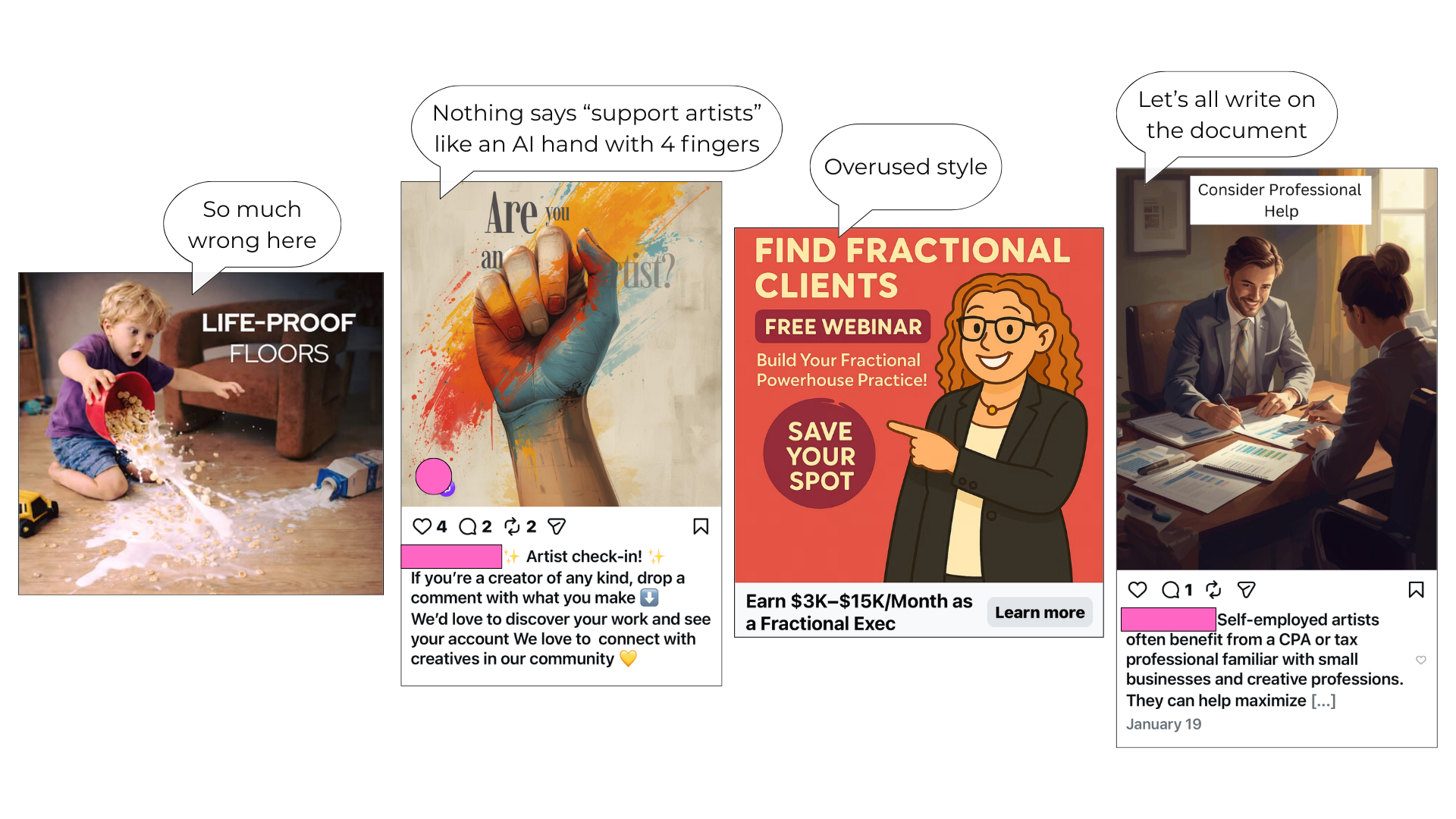
The Life-Proof image works because it catches your attention—obviously fake, but good enough for a mass-market, commodity brand.
Using AI art to show artist support is a big, tone-deaf fail—at least count the fingers before publishing.
I see the “safe, corporate vectors” everywhere from supplement ads to professional services—good enough, but easy to tune out and does nothing to differentiate.
“Consider professional help” indeed. I would like to help this account with their content.
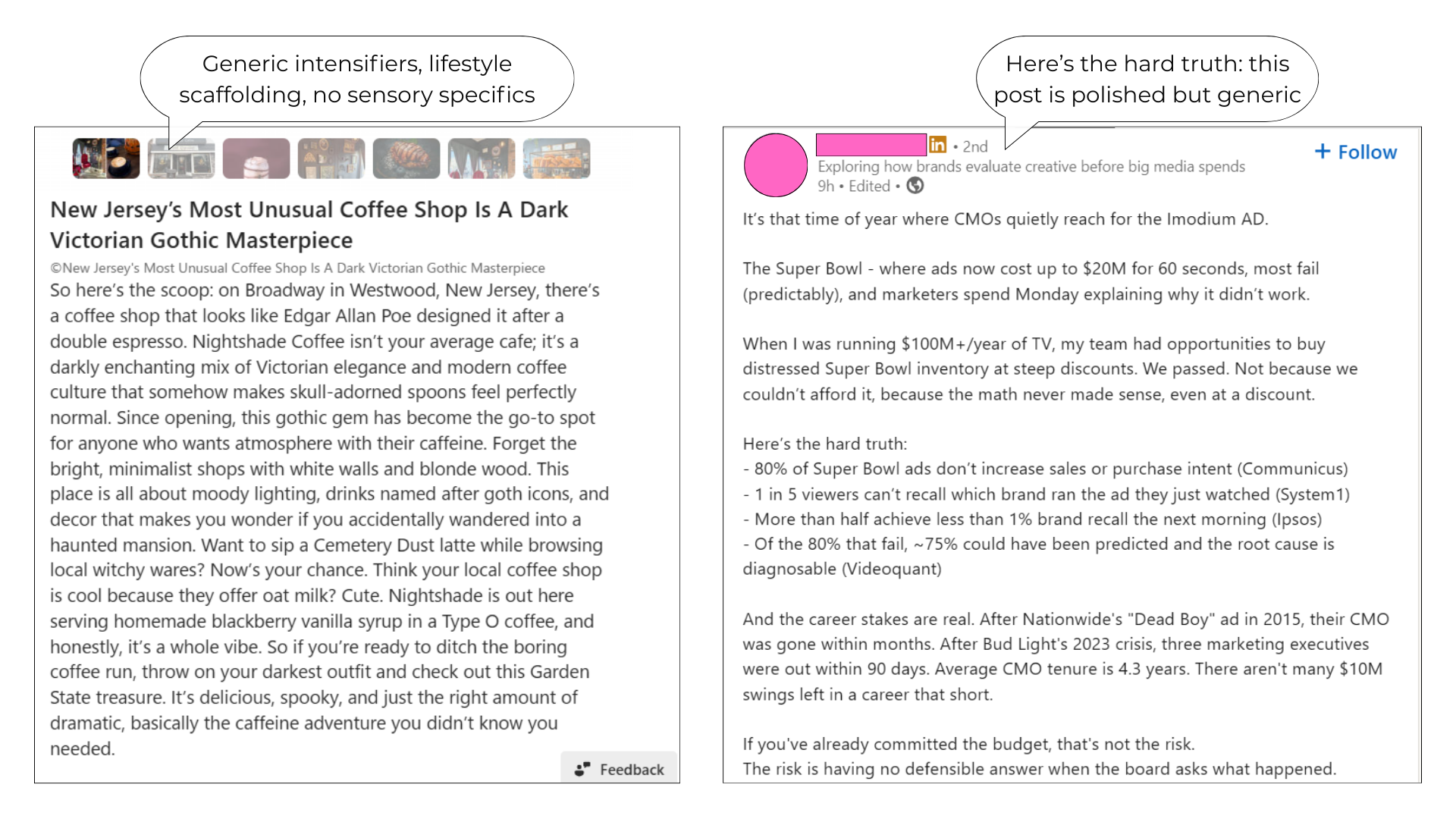
Structurally correct, smoothly flowing, hitting all the right beats—and making a unique coffee destination sound absolutely average. Hype overdrive with little specific detail. Did the author visit this place? Or did they put a press release into Claude along with a prompt for “lifestyle magazine content”?
LinkedIn users feel the pressure to frequently post content. Those who stand out may use AI to identify and deliver top-performing frameworks—and fill them in with their own insights and vocabulary. Those who lead will disrupt the pattern and create winning frameworks of their own.
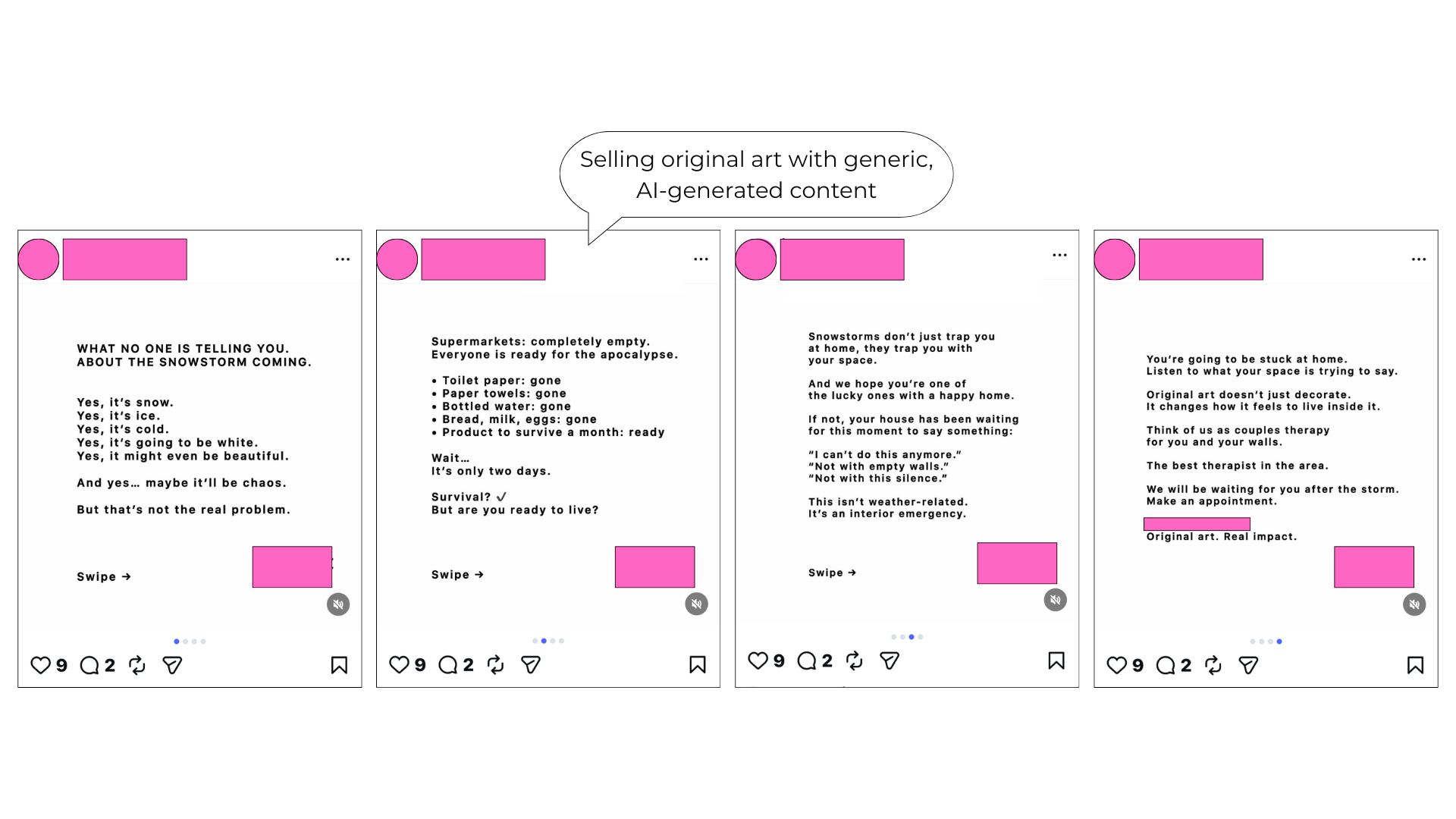
Art galleries, especially those dealing in original art with price tags in the thousands, are known for being creative. So why this generic, hype-filled content that sounds nothing like a sophisticated gallerist? Credibility lost.
The most-AI derivative element of this set is the metaphor scaffold that runs from “What no one is telling you about the snowstorm coming” to “Original art doesn’t just decorate. It changes how it feels to live inside it.” This follows a common LLM persuasion pattern of hook with contrarian framing > expand tension > reveal twist > sell transformation. The opening itself is a high-frequency AI hook.
Other AI-generated elements include over-controlled escalation and pivot, artificial profundity, therapy metaphor, structure optimized to follow best-performing carousels.
While structurally and grammatically polished, the copy here is abstract, broad, and replaceable. It lacks specificity about the gallery, artworks, or clients.
Fun fact: LLMs have a lot of Covid lockdown-era material in their training. You can see a lot of it showing up here.
Let’s look at some common AI content markers:
Repetitive anaphora. These are safe rhetorical devices that mimic depth without providing any new information.
Generic “reveal turn” structure. This is a classic AI persuasion arc that establishes common ground, pauses, and reframes as a deeper truth.
Abstract personification without specificity. High-level metaphors without grounded observation are common in LLM content.
Faux-philosophical minimalism. Short declarative sentences. White space. Vague.
Hype and novelty cliches. These are high-frequency LLM openers and transition phrases used to simulate conversational confidence.
Metaphorical overreach. LLMs often stack whimsical sounding metaphors instead of using concrete sensory detail.
Vague intensifiers (low information adjectives). These mimic tone without adding verifiable or specific detail.
Balance framing cliches. “X without Y” or “it’s not this, it’s that” constructions are extremely common in AI copy.
Overused vocabulary. Quietly. Signals. Noise. Messy. Battle Scars. Shift. Fluff. Clean. Clarity. Chaos. These words show up often in AI because they are noncommittal and don’t rely on specific detail.
Anatomy and physics errors. Odd knuckles, uniform teeth, gravity is wrong.
Text and symbols. Gibberish lettering. Inconsistent fonts. Logos that don’t look quite right. Numbers that are unreadable.
Repetition and model-style sameness. Generic influencer look, overused compositions (centered subject, shallow depth of field, cinematic blur), over-aestheticized scenes that feel like stock photos of concepts, not real places.
Flat, vector illustration. Simplified characters, thick outlines, limited palette, friendly rounded features, “corporate cartoon” tone.
Once you see sameness, you can’t unsee it.
When you buy a new car, you suddenly see that make and model everywhere because you’re aware of it. Generic content is the same, and as people learn to recognize it, they will learn to skim or skip it entirely. Good enough content works for now, but as it continues to saturate our feeds and inboxes it will start to work against you as audiences tune it out. And when people tune out, the outcome changes in terms of performance.
Good enough is generic. Generic is invisible. Invisibility is expensive.
Marketers, business owners, and creators are under a lot of pressure to create content. I provide AI enablement coaching for teams and training for individuals who want to work more efficiently without sacrificing quality. And if you want someone to do-it-for-you, I can help with your copy and content needs. Reach out for a complimentary discovery call to learn more.